We have collected 3000 units for Australia, and we are offering a limited quantity of SEMEN PACKAGES on Stokman Solution for the 2023 breeding season.
Solution is sired by the Origen-ABS top selling bull for 2022, Sitz Resilient 10208, who as of 2-3-23, among all ORIgen sires, Number 4 for score for foot Angle EPD, Number 9 for score for Claw set EPD and Number 10 for $Maternal value index and Hair Shedding score EPD.
Resilient is rapidly becoming known as a “low risk – high reward” sire whose sons have topped sales across the nation for the past two years, the greatest contribution of Resilient is yet to come as his daughters backed by the power of “America’s Maternal Herd” come into production.
Stokman Solution’s EBV’s in NZ are in the top 1% for Calving Ease Direct, Gestation Length, Birthweight and EMA, but is a curve bender being in the top 5% for 200, 400, 600, Carcass Wt, DTC and IMF. He finishes out being in the top 1% for $A and Angus Pure Index. He goes back to an elite cow family, who has produced several herd bulls, one selling to Turihaua Angus, Stokman Southern Charm P228. Solution ticks all the boxes, and this is an opportunity to use him in your breeding programmes to improve maternal, growth and carcass traits.
Genomic testing has come a long way during the past decade, improving the accuracy of breeding values for yearlings. Sarah Horrocks visited yearling specialists Stokman stud near Rotorua to find out how their business is doing.
When you’re looking for bulls, where do you start? There are two-year-olds, yearlings, registered or bush bulls, private sales and auctions. Prices vary immensely between the various options, but one thing is certain, science has proven that without reputable genomic evaluation on any given animal, it’s all a guessing game.
The Stokman bloodlines have been in the Angus cattle game for more than a century and Stokman stud has now been in operation for more than 25 years in the Waikite Valley near Rotorua.
Sherrie Stokman hails from Sitz Angus in Montana, in the United States, and the family farm is run by her and husband Mark, son Jake and stock manager Craig Moyes. Yearling bulls are their specialty, and they sell plenty of them.
The breeding programme was developed around profitability and the practicality of using yearling bulls in both heifer and cow mating programmes.
“They’re easier to handle, shift easily and they’re more economical,” Sherrie says.
Mark insists that the first point of profit in any beef breeding programme is having a live calf on the ground. He says there’s data available on bulls to ensure the predictability of a female producing a calf that will calve easily with a moderate birthweight and go on to have above average growth.
“That’s a profit point,” says Mark.
Yearling bulls provide the latest genetics available in the industry and that’s why they are so appealing to Stokman clients.
With genomic testing, the accuracy of the estimated breeding values (EBVs) available for yearlings has come a long way. Ten years ago people were worried about buying a yearling as they weren’t proven as a sire and their EBVs weren’t as reliable as those of a two-year-old. Accuracy on a bull increased as the number of progeny increased.
HD50k genomic testing changed all of that. It greatly increases the accuracy and scope of predictions for young bulls and females with limited or no progeny. A yearling bull that has been HD50k tested has EBVs that are more accurate than a large number of the two-year-old bulls being sold here in New Zealand without genomic testing.
In 2022 Stokman calved down 376 females – 300 mixed age (MA) cows and 76 R2 heifers.
There are 100 bulls catalogued for the yearling sale in September and Stokmans plan to increase this number in future. The bulls are selected for their suitability for heifer mating (calving ease) while still possessing data to provide good growth and carcase attributes.
Mark says a farmer might want a big calf that has huge growth, but if it has to be pulled out the calf might not make it. The farmer has lost the opportunity of that cow’s production for a year. With today’s genetics curve bending sires can be easily identified.
“Looking at the calving traits is really important for heifer mating.”
Mating heifers is not just preached, but practised by Stokman, with all heifers mated at 15 months, and Mark is blunt when asked about the idea that this generates the most profitable return on females.
“Unless you’re farming for a hobby and don’t want to make money, you mate yearling heifers.”
While a heifer’s calf won’t always have the same growth as a calf out of an MA cow, Mark says commercial farmers should look very closely at retaining their replacements out of the heifer calves.
“They should be your best genetics,” he says.
Jake says by 15 months old the heifer’s calves have caught up and it’s hard to pick them out among their contemporary group without their tag numbers.
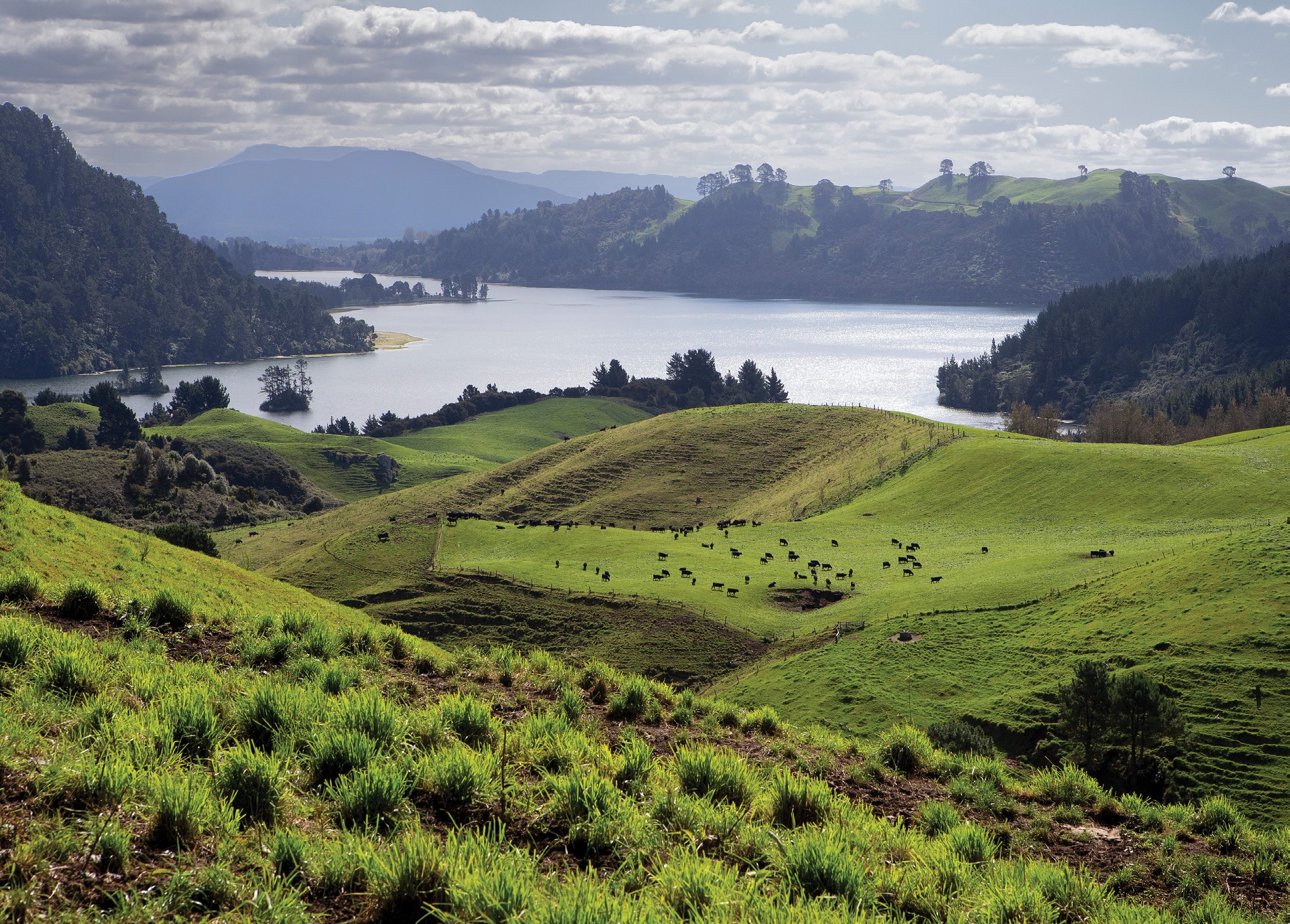
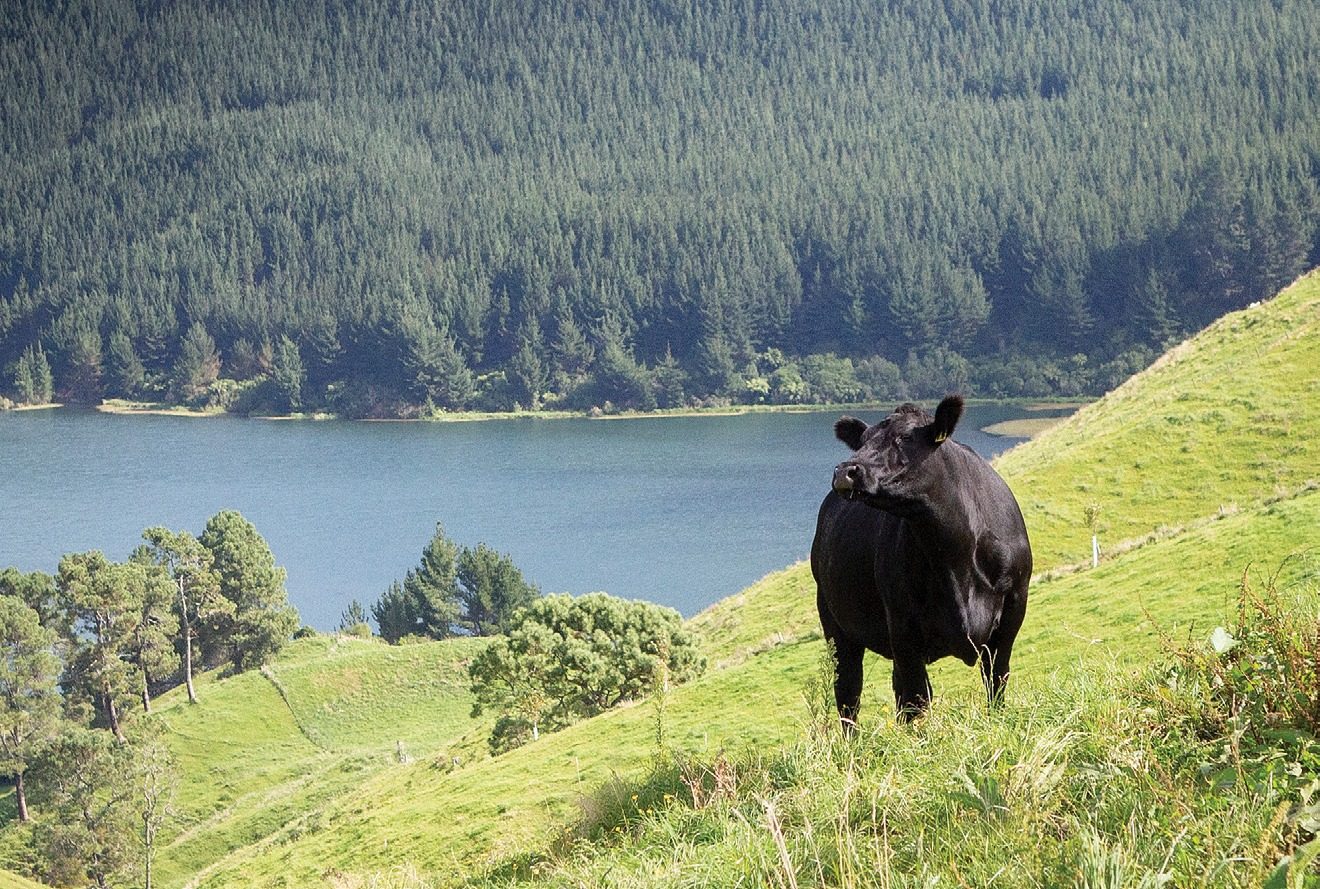
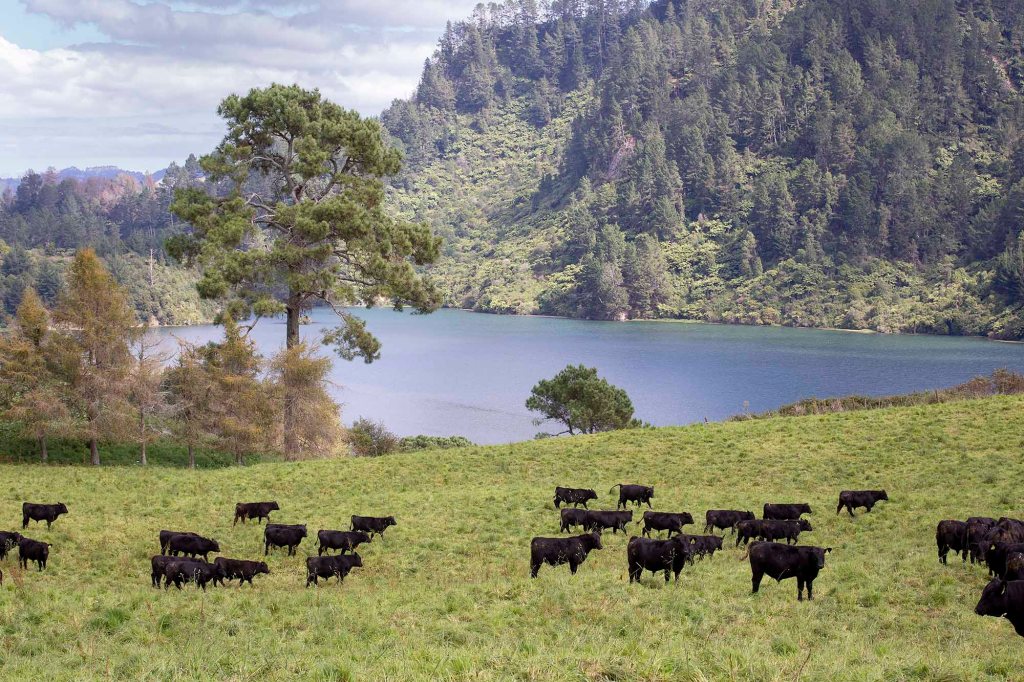
The farm is set in a stunning location, along the shores of Lake Ohakuri on the Waikato River. It ranges from 340m above sea level at the lake shore to 480m on the tops.
Conception
The cycle begins with a planned calving date of August 1 for the heifers and August 14 for the MA cows at Stokman. It’s a short gestation herd so the team can expect to see calves on the ground up to 10 days earlier than that. This isn’t something that was sought, but rather a by-product of selecting for lower birth weight and calving ease.
The short gestation is also beneficial for the reproductive cycle with the cows often in their second or third cycle by the time mating starts, which increases the reconception rate.
“We end up with a tighter calving pattern,” Mark says.
That calving pattern will see 89% of the pregnant females calving within a six-week period in 2023. The total empty rate is 7% in the MA cows and 8% in the yearling heifers.
Only 75% of the cows are put through one round of AI, with the average conception rate just over 70%. The cost and management time is significant, which is why not all females are impregnated via AI.
Mark says semen, AI and CIDRs cost about $150-200 per cow.
The total cost spent on AI in 2022 was $61,000, without any management time included. A third of the bulls used for AI are bred by Sitz Angus in Montana, renowned in the US for their quality of females.
“They’re a strong maternal herd and they’re family,” Sherrie says.
Stokman are looking to bring in more intramuscular fat (IMF) and carcase into their progeny, so for this they are on a global hunt for sires.
“We’re bringing IMF in slowly to ensure we don’t sacrifice the maternal ability,” Mark says.
There’s just one cycle of AI and then the bull goes out for eight weeks, as it does for all other females too. Herd sires are sought from other NZ studs, with Stokman having used Ngaputahi, Storth Oaks, Hallmark and Te Mania sires in the past. For their heifer mating programme they hold back their two top yearling bulls each year.
When looking for bulls for their own programme, aside from the maternal attributes and hunting out the curve benders with low birthweight and top 20% growth EBVs, IMF is important.
“They have to be above the Australian breed average of 2.2 for IMF,” says Sherrie.
Pregnancy testing and foetal dating in January identifies the females who got in-calf to AI and early natural mating.
The cattle are farmed in a rotational grazing system across the 390ha (effective) farm. The topography is about one-third easy country, one-third medium hill country and a third steep.
Stokman cows live in the hills for most of the year, only coming down to calve behind a wire for management; calves must be tagged, weighed and DNA sampled at birth.
HD50k testing costs $20,000 a year but the benefits far outweigh the cost.
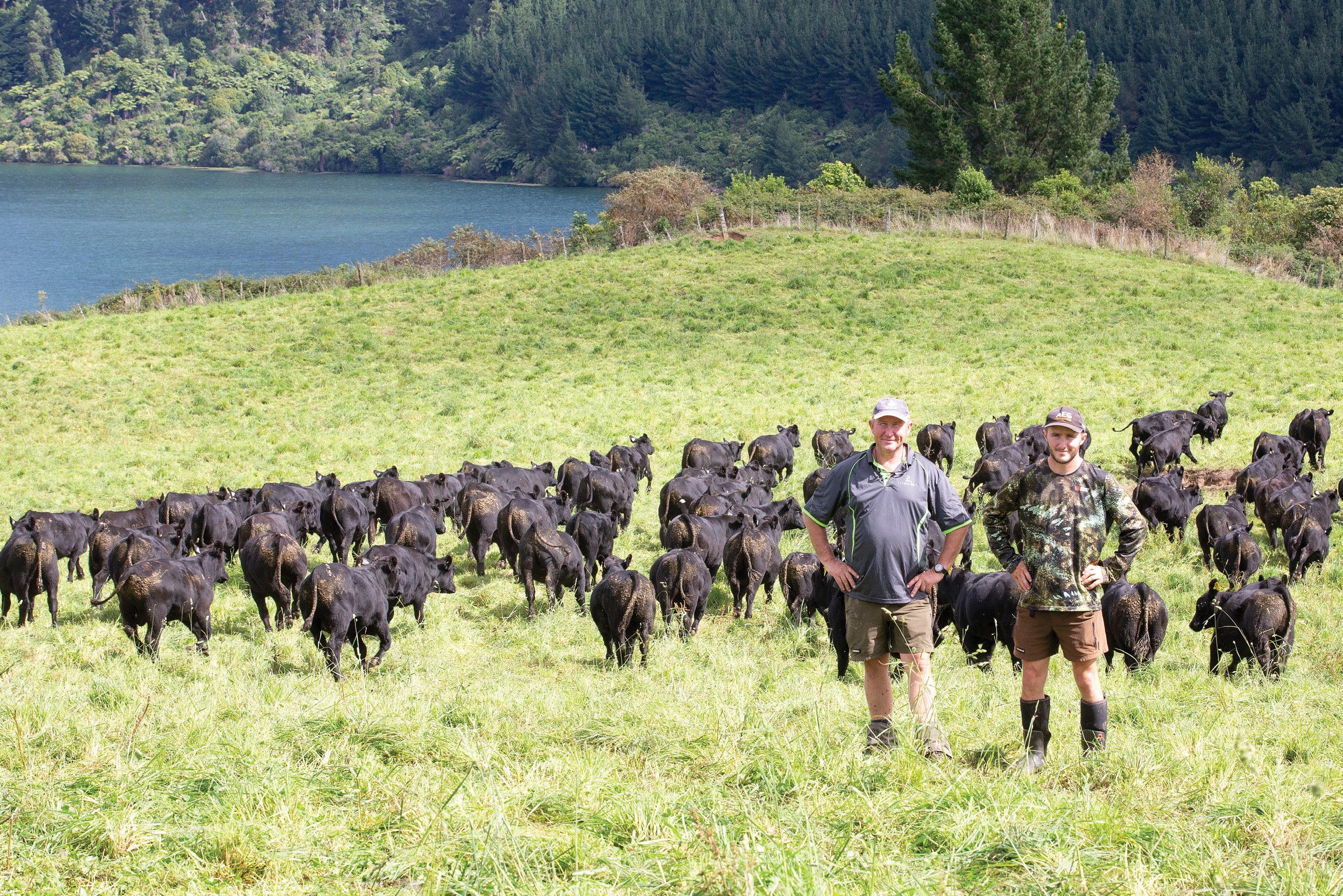
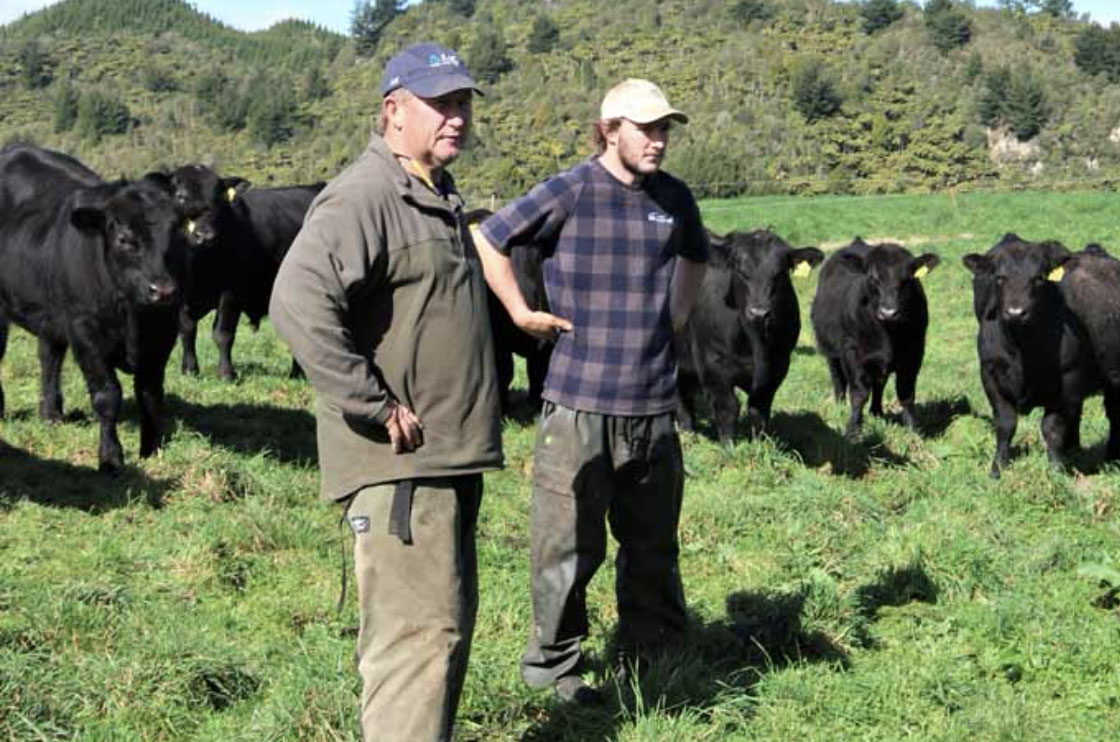
Mark (left) and Jake Stokman. With genomic testing, the accuracy of the breeding values (EBVs) available on yearlings has come a long way.
Young stock the priority
In early to mid-February the calves have their 200-day weight measurement collected, docility score taken and are weaned. “The cows are put to work after weaning,” Jake says.
The heifers and bulls are separated and run in mobs of 180-210 depending on the ratio of bull to heifer calves in any given year.
The bulls are fed to achieve a weight of 1kg plus/day, which gives a target liveweight of 500kg plus on sale day in September. On June 1 the weaner bulls are broken into two mobs of about 80-90 to reduce behavioural problems and make management easier over the winter months. The 120 potential sale bulls are selected in July and once selected are run in smaller mobs of 60, yet still fed the same as all the other young bulls so they can be compared equally against their contemporary group.
In July all the young bulls are carcase-scanned and the heifers are done in January. It ensures physical evidence of the progeny they are taking back into their herd and also improves the accuracy of the EBVs.
The bulls are fertility tested in August and then sold via auction at 13 months old. Of the bulls sold, about 20% are more suited to cow mating than heifer mating.
“These bulls are breed average or slightly above for birthweight,” Mark says.
While these bulls aren’t in the breeding policy, there will always be genetic outliers. While Stokman closely monitors sires to reduce the number of higher birthweight bulls, they are still a valuable option for cow breeding.
In 2022 Stokman decided to host a two-year-old sale in June as an outlet for these higher birthweight bulls. However, that created mixed messaging around the two different sales, so they don’t plan to host a second auction again in the near future.
Sherrie says they received a lot of feedback from their regular clients saying Stokman was creating a distraction from their main focus – the yearlings.
“Our clients know the value of a yearling,” she says.
Jake says when they initially discussed the idea of a two-year-old sale, they made the decision that the best bulls would always be sold as yearlings.
“We stand by that decision.”
Going forward they will now farm a handful of bulls through, to be sold by private treaty. It also means there will always be bulls there to assist any clients in need of a bull throughout the year.
“The most important thing is to get cows in-calf,” Mark says.
There are also another 35-40 bulls sold by private treaty as yearlings, mostly to the dairy industry.
“We sell 80-90% of the sale bulls to the beef industry,” Jake says.
While Stokman do sell bulls to the dairy market, it’s the commercial beef farmer who gets a return from his bull for at least four years. They are prepared to pay the bigger money for a bull at auction. However, in the past three years, Jake says they’ve had dairy farmers paying up to $6100 for bulls.
Mark says the beef farmer buys a bull for finishing and weaner progeny, as well as the female replacements going back into his herd. The dairy farmer just wants live calves on the ground.
The total income generated from selling registered bulls in 2022 was $763,000, the majority share in the gross farm income of $2700/ha. The top priced yearling bull in 2022 smashed NZ records. Stokman Solution S329 sold for $55,000 (not included in total bull sales) and that was for semen rights in Australia only. This means they kept him on farm to use at Stokman and his semen will also be available for sale here in NZ this year.
“That was a win-win for us,” Jake says.
The girls
Stokmans keep 75 heifer replacements annually. Of the remainder, they sell 40 as yearlings at the bull sale in September and about 80-90 are sold in-calf over the summer and autumn – all unregistered.
Every year there are about 20 heifers that are culled and sold fat through progressive meats at Wilson Hellaby for the Countdown Angus brand.
Mark says getting more information from meat plants rather than just weights would be beneficial for their programme.
“We really want that carcase data back.”
The fat heifers are killed either just prior to or during the second winter (20+ months) when the schedule is higher. They kill above 240kg CW.
Winter brings the highest stocking challenges for Stokmans, with 4900 stock units on board, so the less finishing stock they have to carry through the better.
As well as the cows and young weaner stock, there are 60 autumn calving commercial cows with their young calves at foot during winter. At 15 months old the bull progeny from these are sold unregistered to the dairy industry and the heifers are sold to a repeat buyer. Mark says there’s a market for these autumn-born bulls and heifers.
“Some dairy farmers like using a 15-month-old bull in their autumn calving herds.”
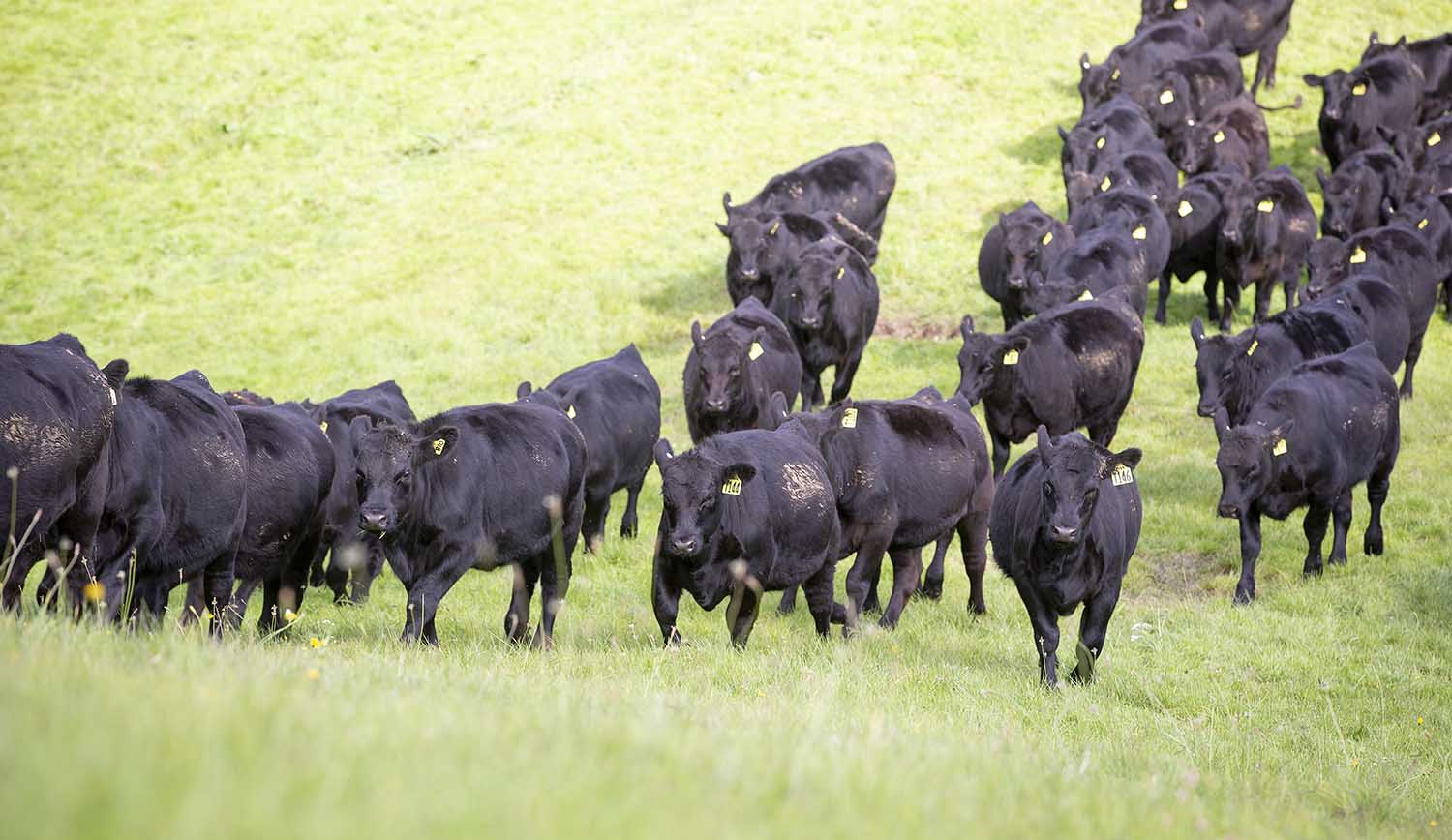
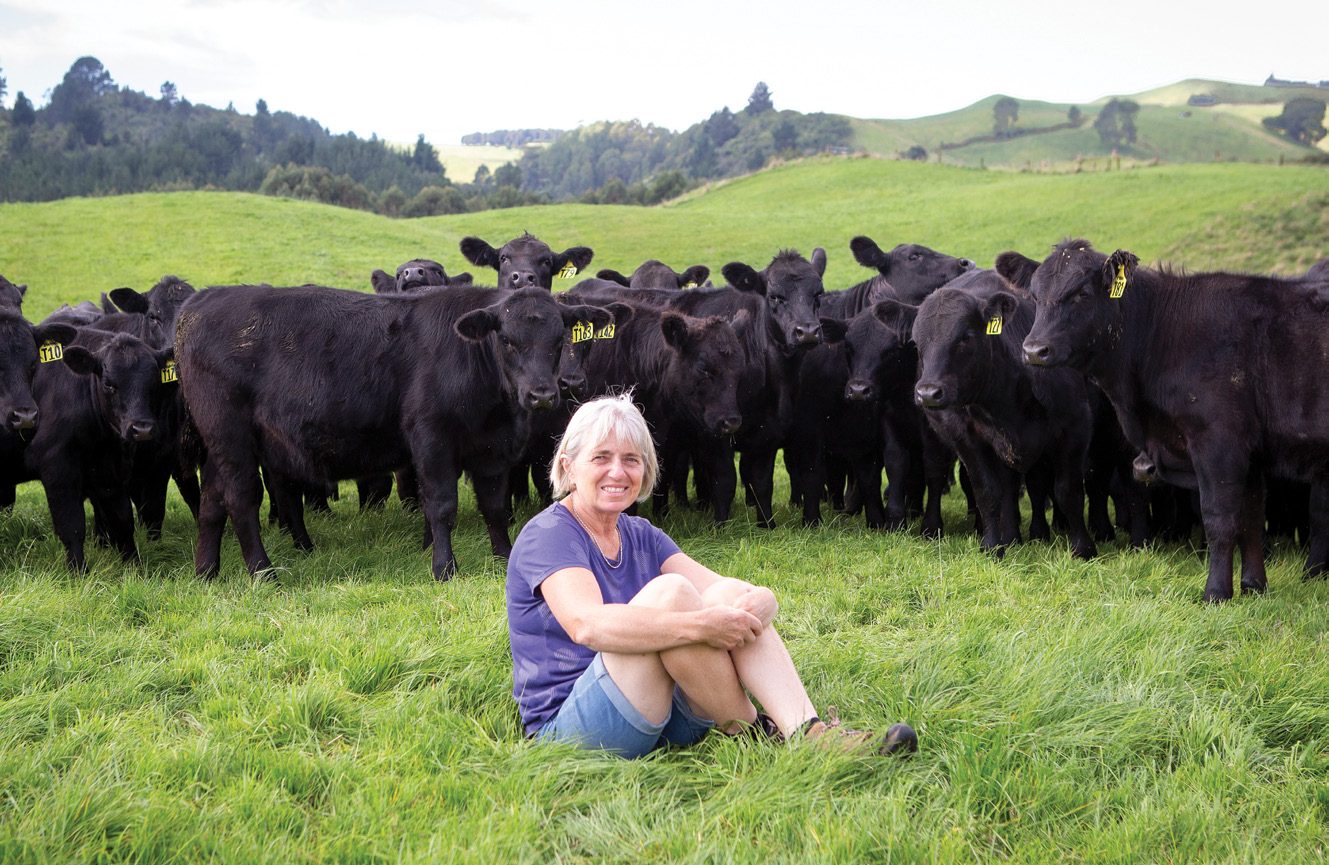
Sherrie Stokman in her happy place – out with the young weaner heifers on the hills at Stokman.
No shortage of feed
Although winter and summer droughts bring challenges to farming in the pumice soil, feed is grown in abundance. Pasture quality is crucial and anything that can be cut for silage or cropped gets the tractor over it.
There’s about 35ha of relatively flat land around the sale barn that’s in a five-year rotation for new grasses – predominantly clover and Italian ryegrass.
Across the whole farm there is 20ha put into crop for wintering the young stock and cows.
Jake says they make 1000-1500 bales of silage every year from surplus feed and some of this is sold to nearby dairy farmers. This is all done by contractors, but all the cultivation and re-grassing is done by Jake with the Stokmans’ own gear.
“This means it’s done when we need it done.”
The high cost of fertiliser this year has seen the Stokmans pull their fertiliser budget back, but it’s still costing about $180,000.
“We’ll be mining some of our fertility,” Mark says.
There won’t be any phosphate going on the flats, with Olsen P levels sitting at 45-50. The hills are at 15-23, so there’ll be 20 units of phosphorus flown on by helicopter in two or three split dressings, with a DAP base.
The average acidity is pH 5.9 and the paddocks in crop receive three tonnes of lime/ha. Twenty units/ha of potassium goes across the farm in December to assist with clover production.
Mineral deficiencies
The pumice is deficient in minerals so animal health is a big expense at $9.61/su, with an additional $2.95/su for Crystalyx tubs. These are available to all females from pre-calving through till the end of mating, to compensate for the high mineral deficiencies in the soil.
Vaccinations include leptospirosis, BVD, Covexin 10 and salmonella.
There is a regular programme to administer B12 selenium every three months and copper boluses two or three times a year across all classes of cattle.
Drench is given in a mix of pour-on and oral, with weaners drenched every eight weeks from two weeks after weaning until 15 months of age. From then on drenching is on an “as needed” basis only, with mature cows rarely getting drenched. Lice control is occasionally required.
Diversification
The farm is set in a stunning location, along the shores of Lake Ohakuri on the Waikato River. It ranges from 340m above sea level at the lake shore to 480m asl on the tops. There is abundant geothermal activity in the area with Orakei Korako just a few hundred metres away by boat and the popular Paradise hot water pool within swimming distance.
The Stokmans used to sell bulls at Waikato combined sale and Taupo sale yards before building their new sale-barn venue in 2018. The long-term vision is to host weddings and corporate functions there for additional income. Covid didn’t play nicely and has put them at least two years behind. However, they have hosted two weddings to date and there are a number of corporate groups who use the venue, including Fonterra.
“They love looking out at the beef cattle, but luckily we have high milk EBVs on our cows,” Mark jokes.
Jokes aside, Mark believes they should take every opportunity to showcase their product to anyone who passes through the farm. This is shown at their new accommodation pods, where all guests receive complimentary AngusPure steaks to dine on during their stay.
The self-contained pods were finished in early 2023 and designed as an add-on to an existing family cabin that sits alongside the sale-barn venue. The old cabin has been updated to now include flushing toilets, gas hot water and solar power. The investment set the family back more than $100,000 (excluding the solar) but Jake is adamant it’s good future-proofing for the overall business.
Craig’s wife Courtney assists Sherrie with operations at the accommodation and sale-barn, ensuring the grounds are always immaculate and the gates are kept shut to wandering cattle.
A licensed pheasant preserve brings in a group of six regular hunters who stay in the cabin. To maintain the licence, Fish & Game requires the Stokmans to buy in 400 pheasant poults every year, which is a considerable expense of course, but there’s a flow-on benefit for the winter crops.
“They tend to eat a lot of the bugs without damaging the crop,” Mark says.
Despite Cyclone Gabrielle bringing minor damage to races, it’s nothing a bulldozer or digger won’t fix, and Mark and Sherrie feel fortunate they escaped relatively unscathed.
Capital development is now in a holding pattern for a year or two across the farm, with the team focused on maintaining and improving the existing infrastructure.
Genomics and scientific research have been a game-changer in the beef industry and the Stokmans have harnessed that power to ensure buying yearlings is no longer a guessing game.
Stokman Angus is busy calving and preparing for their annual yearling sale on September 20, where they will be offering more than 100 bulls and 40 heifers.
Jake Stokman says there are good reasons for farmers to buy yearlings instead of two-year-old bulls.
“Firstly, they are cheaper.”
Raising two-year-old Angus bulls this winter averaged more than $9500.
“At our sale we averaged $5700 on 100 bulls, but there were 40 per cent of the bulls that sold for between $2200 and $4000.
“You also get more use with yearling bulls, as you get an extra breeding season out of them, and faster genetic gain as you can introduce newer genetics into your herd a year earlier.”
Jake says yearlings are usually fitter and more agile as they are still growing, and haven’t got all that extra weight.
“You just need to ensure they are well grown when you purchase them, and look after them after mating season. They mix in the herd better and are easier to handle than older bulls.”
Earlier breeding means the bulls are maintained at weights below their genetic potential and as a result, less stress on their skeletal structure.
“Our bulls are well grown and will average more than 500kg on sale day. They are HD50k tested for more EBV accuracy, carcass scanned, fertility tested and are known for their docility.
“We concentrate on calving ease, short gestation, low birth, above average growth and adequate carcass traits. It’s all about balance!”
SOURCE: Coast & Country News, Friday 15 September 2023
We extend a sincere invitation to join us at our 14th annual yearling sale on Wednesday, September 20th.
Angus cattle have been in our history for over 100 years, with Sherrie’s family ranch, Sitz Angus, reaching the milestone of 100 years producing Angus bulls in Montana. For us, raising cattle is a way of life we enjoy, but we also take it very seriously. The bulls you purchase today are an investment in genetic progress in your herd, and for you to get the most potential out of your investment, we work hard to provide the most accurate data we can We start by HD50K dna testing every registered calf born on the farm. We docility score at weaning. Finally, we carcass scan and fertility test every sale bull to provide the product you see today.
We strongly believe in selling yearling bulls, as besides getting faster genetic gain since you can introduce newer genetics into your herd a year earlier, yearlings are usually fitter and more agile, haven’t got all that extra weight and are less prone to injury. They are also much better value for money, as with R2 Angus bulls averaging over $9500 this year in the autumn sales, yearlings are much more affordable. In our 2022 sale, we averaged $5700 on 100 bulls, but there were 40% of the bulls that sold for between $2200 and $4000. The bulls are well grown and will average 500 kgs on sale day, so are suitable for both heifers and cows.
The 110 bulls in this catalogue are the most uniform group we have raised, and are sired by some of the leading bulls in the Angus breed, and we are very proud to present them. We value temperament, and have had amazing feedback on how easy our bulls are to work and handle.
The 40 heifers have been selected from the registered herd, but sell without transfer. They share the same sires as the bulls, and will sell in pens of 10. Ebv’s and Indexes will be available on each pen sale day.
We have continued to thrive in our relationship with Angus Australia, and they are continuously developing new EBV’s and indexes, that will improve our cattle selection. If you have problems accessing our data on Angus Australia, please don’t hesitate to give us a call so we can help.
Thanks to Craig and Courtney Moyes who have been with us for six years, and are a very important part of our team. Craig and Jake work together very well, and this has given Mark time to be able to achieve all those little jobs that keep things running smooth.
If you enjoy the native gardens at the salebarn, Courtney keeps things looking stunning. And we are overjoyed that Jake and Lexie are engaged, and are looking forward to a big wedding in the salebarn sometime in the future. Lexie is full time employed with the Govt Apprenticeship program, but is always there to help Jake on her days off, and we appreciate it and that she loves the farming life.
We look forward to seeing you on September 20th. If we can be of any assistance, please let us know. The coffee pot is always on if you are over our way.
We invite you to join us at our online rising 2 year old bull sale, the evening of Monday, June 12 at 7:30pm. We only have 15 bulls and a herd bull in the sale lineup, so have opted for just an online sale this year. We do welcome anyone that would like come look over the bulls ahead of the sale – just give us a call to organize. The auction will be through BIDR. If you need help signing up, their phone number is 0800 TO BIDR, or contact them on bidr.co.nz.
The sale bulls were selected as they were either used in our own herd last spring over heifers, or were outliers for our spring program. They were summered on the hills, and just brought down to the flats the last few months. They will be fertility tested by Guy Hayes, Totally Vet Services, Fielding on June 7th.
Also in the sale at Lot 16 is Te Mania Tussock, whom we purchased from Te Mania Angus for $32K in 2019. Tussock has calving ease and very short gestation, and huge growth and carcass weight, great structure and temperament. We have retained a number of daughters in the herd, and he is surplus to our requirements.
Our goal has always been to breed cattle to do the things cattle were meant to do. We want them to calve unassisted, milk, breed back, and grow rapidly while bringing in carcass traits without losing the qualities that have made the Angus cow the most popular beef cow in the world.
Our main focus will continue to be on our yearling sale, which will be offering 110 yearling bulls and 40 heifers in September.
We would like to thank our great team, our son, Jake and his fiancée Lexie, and Craig and Courtney Moyes for their hard work and dedication to making the farm operate smoothly. The farm and the cattle just keep getting better under their watch.
If we can be of any assistance, please let us know. The gate is always open for visitors to come look over the bulls and cattle, and the coffee pot is on if you are over this way!
We look forward to hearing how the bulls work for you – we appreciate all the feedback from you, as the bulls are an investment for you . . . and we want it to be a profitable one!
Mark, Sherrie and Jake Stokman feel they have a duty to provide the beef sector with cattle that are improving year on year.
Every technological tool is used to ensure everything there is to know about Stokman Angus is available.
Every registered calf born is HD50k DNA tested at birth which increases the EBV accuracy and verifies parentage.
Not all breeders verify parents and it is amazing the cows that switch calves, Jake says.
“We even had twins out of two different sires, DNA takes away the guess work.”
Sale bulls are carcass scanned and fertility tested by Totally Vets, ensuring the bulls are 100 per cent ready to go when leaving the farm.
Stokman Angus’ annual spring sale is coming up on Wednesday, September 21. One hundred yearling registered Angus bulls and 40 R1 heifers will sell, starting at 1pm.
Thirty bulls will be carried on to put in the June sale, which are higher birthweight, cow mating bulls.
The remaining bulls are generally sold by private treaty to local dairy farmers looking for low birthweight, easy calving genetics.
“One of our main breeding philosophies is that we want farmers to be able to go home at night and wake up in the morning and the cattle have calved down and they don’t have to worry about a heifer that’s had a problem calving,” Jake says.
Like his parents, Jake believes that when you purchase a Stokman bull you’re buying an investment for the future.
We extend an invitation to join us at our 12th annual yearling sale.
Though we are in lockdown at the moment, we feel very lucky to have led a fairly ordinary life for the past year and have enjoyed strong beef and lamb prices, without having the major weather calamities the rest of the world has endured. Looking at the uncertainty and chaos in many parts of the world, our family feels very lucky to firstly be involved in farming in New Zealand, possibly the best place to produce grass fed protein in the world, and secondly, to be raising Angus cattle, the best beef breed in the world.
Our goal has been to breed cattle to do the things cattle were meant to do, calve unassisted, milk, breed back, and grow rapidly while carefully bringing in carcass traits, without losing the traits that have made the Angus cow the most popular beef cow in the world.
Emphasis on the female has always been of utmost importance to us. The quality of the female is the key to a successful breeding program, and from good cows come great bulls.
We calved 250 head of registered Angus cows this spring, and 80 commercial autumn calvers in March, as well as fattening around 200 head of steers and heifers.
There are 100 well grown bulls that will sell on September 15th. We have carcass scanned all our yearling bulls with Austin Ultrasound to get most accurate information we can, and EVERY bull offered for in this sale has passed the BBSE, Bull Fertility Soundness Evaluation with fertility guru, Guy Haynes from Totally Vets. We also value temperament, and have had amazing feedback on how easy the bulls are to work and handle.
40 heifers have been selected from the registered herd, but sell without transfer. These heifers share the same sires as the bulls. The pens of 10 will have AngusPRO indexes available on sale day.
We would like to thank our great team, our son Jake and Craig and Courtney Moyes for their hard work and dedication and the farm and cattle just keep improving under their watch. We also want to thank you, our valued customers, for your trust and confidence in our program. We will continue to utilize very tool available to produce the best Angus cattle we can, combining phenotype, EBV’s, technology and Common Sense.
We look forward to seeing you on our new sale date, September 29th (postponed due to lockdown). If we can be of assistance in any way, please let us know. Always love showing our cattle and the coffee pot is always on if you are over this way!
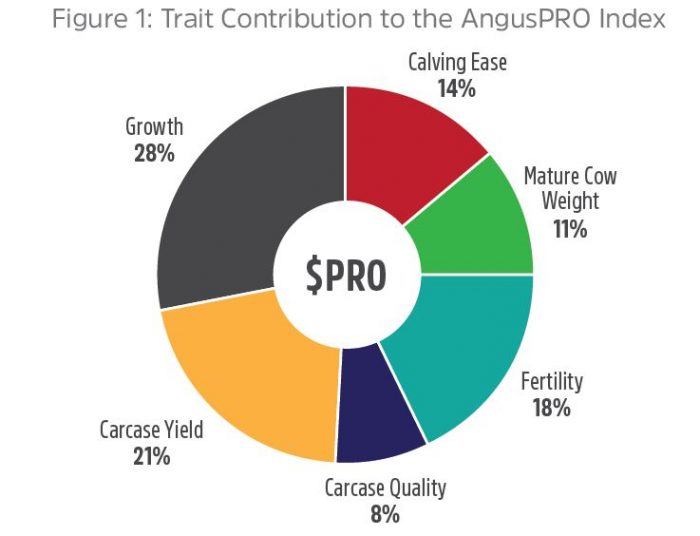
The AngusPRO index ($PRO) estimates the genetic differences between animals in net profitability per cow joined in a commercial self replacing herd based in New Zealand that targets the production of grass finished steers for the AngusPure programme.
Daughters are retained for breeding and therefore female traits are of importance.
Steers are assumed marketed at approximately 530 kg live weight (290 kg carcase weight with 10 mm P8 fat depth) at 20 months of age, with a significant premium for steers that exhibit superior marbling.
Trait Contributions
Figure 1 shows the traits that are considered in the $PRO index, and how much they contribute to the overall balance of the selection index. The larger the segment, the greater the impact on the selection index.
Selection Advantage
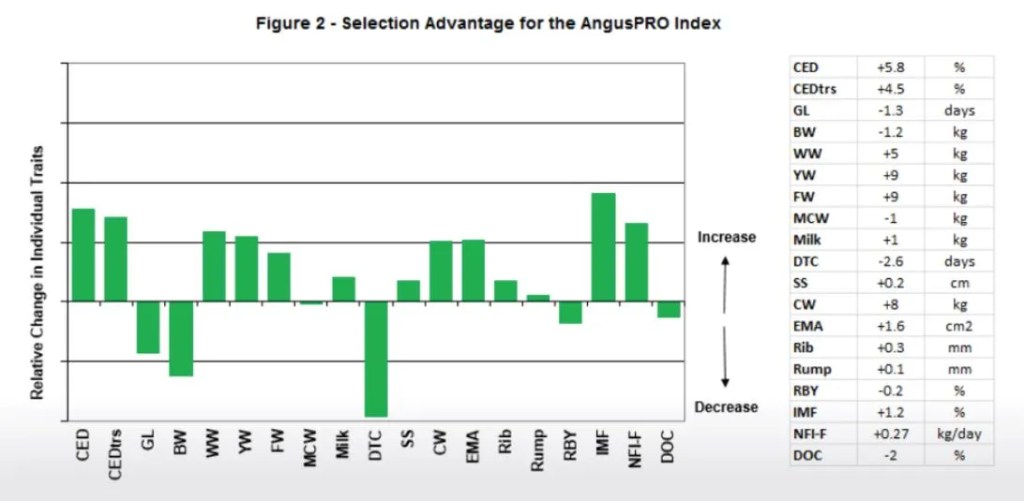
Figure 2 shows the selection advantage if animals are selected using the $PRO index.
The selection advantage is calculated by ranking well used sires within the Angus breed on the $PRO index, and comparing the average EBVs of the sires in the highest 10% with the average EBVs of all sires from which they were selected. For example, the sires ranked in the highest 10% based on the $PRO index had 9 kg higher 400 Day Weight EBVs and 1.2 kg lower Birth Weight EBVs than the average EBVs of the sires from which they were selected.
The selection advantage is indicative of the long term direction and relativity of response that will occur in individual traits if selection is based on the $PRO index. The actual response that is observed will vary depending on the features of the individual breeding program.
A feature of the $PRO index is a selection advantage of close to 0 for mature cow weight, meaning that selection on this index will maintain mature cow weight, while still increasing growth to 200, 400 & 600 days of age.







 Stokman Angus